
Ponca Trail of Tears: The 1877 Removal Across Nebraska
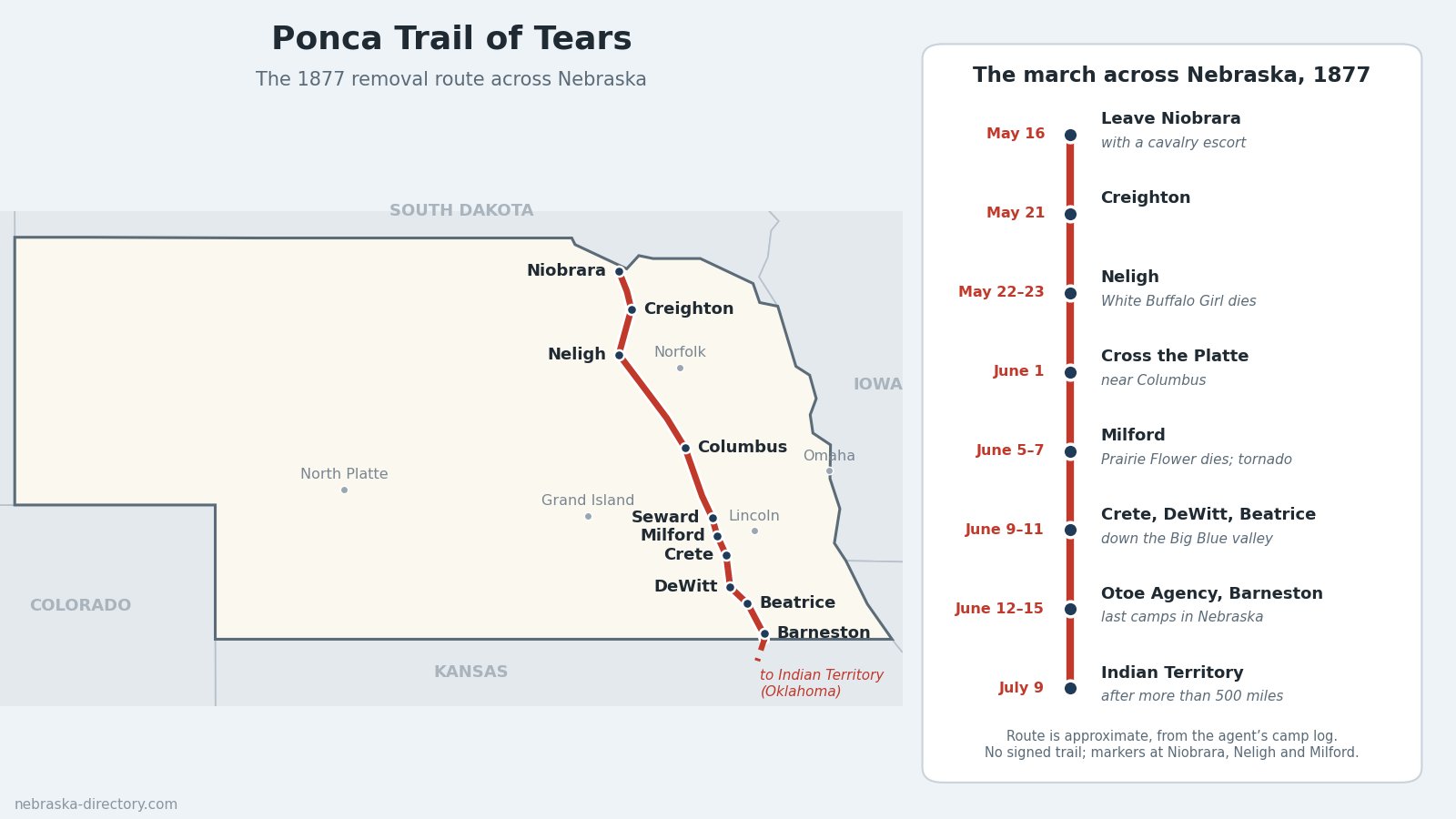
The Ponca Trail of Tears is the route of the forced removal of the Ponca people from their homeland along the Niobrara River and Ponca Creek to Indian Territory, in present-day Oklahoma, in 1877. The main group left Niobrara on May 16 and spent about a month crossing Nebraska, by way of Neligh, Columbus, Milford and Beatrice, before entering Kansas in mid-June. Two Ponca children who died on the way are buried in Nebraska towns that still remember them. The march led directly to the 1879 trial of Chief Standing Bear, one of the most important court cases ever heard in Nebraska.
At a Glance
- When: The main group left Niobrara May 16, 1877, crossed into Kansas about June 16 and reached Indian Territory July 9. A smaller first group of about 170 had gone ahead in the spring.
- Distance: More than 500 miles in all, about a month of it in Nebraska.
- People: About 730 Ponca were removed. Nine died on the march, and 158 died in the first two years in Indian Territory: more than one in five of the tribe.
- Is it a marked trail? No. There is no signed route to drive or walk. The removal is remembered at historical markers, graves and a museum along the way, listed below. Bills to study a Chief Standing Bear National Historic Trail have been introduced in Congress but not passed.
- Counties on the route: Knox, Antelope, Platte, Seward, Saline and Gage.
The Homeland
The Ponca lived along Ponca Creek, which rises in Boyd County, runs east past Lynch and joins the Missouri River east of Verdel in Knox County, and along the lower Niobrara River. They farmed and hunted from earth-lodge villages here for generations. This is Highway 12 country today, the Missouri River corridor along Nebraska's northern border.
The tribe's name also lives on farther east: the town of Ponca and Ponca State Park, on the Missouri River in Dixon County, are named for the Ponca, though they lie outside the homeland described here and off the 1877 route.
The Route, Day by Day
The dates below come from the camp log kept by Indian agent E. A. Howard, who led the main group.
- May 16: The main group leaves the Niobrara area with a cavalry escort and crosses the Niobrara River.
- May 21: Camp at Creighton.
- May 22–23: Camp at Neligh. White Buffalo Girl dies here on May 23.
- May 24–31: The group crosses the Elkhorn River and camps along Shell Creek, held up for days by rain and high water.
- June 1: Across the Platte River near Columbus.
- June 2–4: South past Ulysses to the Big Blue River and Lincoln Creek, near Seward.
- June 5–7: Camp near Milford. Standing Bear's daughter Prairie Flower dies on June 5; a tornado strikes the camp on June 6.
- June 9–11: Down the Big Blue valley past Crete and DeWitt to within a mile of Beatrice.
- June 12–15: Camp near the Otoe Agency at Barneston, on the Otoe-Missouria reservation.
- About June 16: Into Kansas toward Marysville, then south through Kansas to Indian Territory, reached July 9.
White Buffalo Girl, Neligh
On May 23, 1877, a Ponca child died on the march at Neligh. She was about 18 months old, the daughter of Black Elk and Moon Hawk. Her father asked the people of Neligh to care for her grave, and the town has done so ever since. Townspeople first marked it with an oak cross, and a marble monument followed in 1913. She lies in Laurel Hill Cemetery, and a state historical marker, "Ponca Trail of Tears", stands about 200 feet north of the grave on County Road 198. Hers is the only grave in the cemetery allowed to stay decorated all year.
The bond has lasted. In 2011 Northern and Southern Ponca, with members of the Omaha Tribe, came to Neligh to thank the town for keeping the grave, and in 2018 a Neligh-area farm family deeded 1.6 acres of land along the route back to the Ponca.
Prairie Flower, Milford
Standing Bear's daughter Prairie Flower died of tuberculosis at the Milford camp on June 5, 1877. The next day a tornado tore through the camp and fatally injured one of Standing Bear's grandchildren. Milford residents buried them in Mount Pleasant Cemetery, north of town; Prairie Flower's grave is unmarked. A "Historic Milford" marker stands at B and 2nd streets, and the state marker "Standing Bear and the Ponca Tribe" is at the eastbound Interstate 80 rest area near Milford.
Those Who Stayed
Not every Ponca went south. Local accounts in Knox County hold that some hid in the broken country near Mars, south of Pishelville and close to Venus, rather than be taken. This is remembered locally rather than recorded in the official histories of the removal, and it is set down here as local knowledge.
Standing Bear Walks Home
Standing Bear's son Bear Shield died in Indian Territory around the turn of 1879, asking to be buried in the homeland. On January 1, 1879, Standing Bear set out north with about 30 people. They reached the Omaha Reservation on March 4 and were arrested on the orders of General George Crook and held at Fort Omaha. In Standing Bear v. Crook, Judge Elmer Dundy ruled on May 12, 1879, that an Indian is "a person within the meaning of the law" with the right to a hearing, and ordered the Ponca released.
In 1881 Congress returned land in Knox County to the Ponca who had come north. The federal government ended its recognition of the Northern Ponca in 1966, and the Ponca Tribe of Nebraska was restored as a federally recognized tribe on October 31, 1990. Today it is one of four tribes headquartered in Nebraska, along with the Omaha, the Santee Sioux and the Winnebago. The Ponca Nation of Oklahoma descends from those who stayed in the south.
Places to Visit Today
- Ponca tribal grounds, near Niobrara — the Ponca Tribal Museum, run by the Ponca Tribe of Nebraska, and the Ponca Educational Trail and Earthlodge, with statues telling traditional stories and a statue of Standing Bear (88915 521st Ave.). The museum holds one of Standing Bear's headdresses and is open on weekdays. The grounds are a few miles southwest of Niobrara, across the Niobrara River: take Highway 12 west over the river and turn south at the Ponca sign, across from Niobrara State Park.
- Annual Ponca Tribe of Nebraska Powwow — held the second weekend of August at the tribal grounds southwest of Niobrara. The Ponca agency grounds, the powwow grounds and the Ponka Tribal Cemetery, also known as St. John's Cemetery and established in 1880, are all together there, at 521st Avenue and 890th Road. Visitors are welcome. The tribe also holds a Restoration Powwow each October, marking the 1990 restoration, in Norfolk.
- Niobrara State Park — a historical marker, "The Forced Removal," near where the march began.
- Chief Standing Bear Memorial Bridge — carries Highway 14 across the Missouri River from Niobrara to South Dakota; opened in 1998.
- Laurel Hill Cemetery, Neligh — White Buffalo Girl's grave and state marker. The Antelope County Museum tells the story of the march through the county.
- Milford — the Historic Milford marker, Mount Pleasant Cemetery and the I-80 rest-area marker.
- Chief Standing Bear Trail — a 23-mile rail trail from Beatrice to the Kansas line that follows the 1877 route down the Big Blue valley, past the old Otoe Agency at Barneston. It is owned by the Ponca Tribe and is the only part of the removal route that you can walk or bike today.
- Otoe-Missouria Reservation heritage, Barneston — where the Ponca camped June 12–15, 1877.
- Chief Standing Bear statues — on Centennial Mall in Lincoln (2017), and in National Statuary Hall in the U.S. Capitol (2019), where he represents Nebraska.
Related Pages on This Site
- Chief Standing Bear Trail — the rail trail on the removal route south of Beatrice
- Highway 12 and Highway 14 — the homeland around Niobrara
- US Highway 275 — through Neligh
- US Highway 81 and US Highway 30 — through Columbus
- Interstate 80 and US Highway 6 — at Milford
- US Highway 136 — through Beatrice
- ← All Nebraska Trails
Sources and Further Reading
- Ponca Tribe of Nebraska
- History Nebraska: Ponca Trail of Tears, White Buffalo Girl
- Nebraska Studies: The Ponca Trail of Tears
- Encyclopedia of the Great Plains: Ponca
- Historical marker: Standing Bear and the Ponca Tribe (I-80, Milford)
- Antelope County Museum: Making History’s Once-Invisible Trail
- National Park Service: Ponca Powwow Grounds, Museum and Educational Trail